 Delegare House

A prospective customer fills out your form, asks about availability, requests a quote, or starts a booking. They are interested now. Then the message sits unanswered while you finish a client appointment or handle everything else competing for your attention. By the time you reply, the urgency has shifted. That is why hot lead follow-up is less about aggressive sales and more about protecting momentum.
At Delegare House, we see lead leakage as an operations problem before a marketing problem.
Businesses work hard to generate demand, then lose opportunities because the response process depends on whoever happens to notice the inquiry. Strong hot lead follow-up gives that interest a clear path forward without requiring the founder to stay glued to an inbox.
1. Interest has a half-life
When someone raises their hand, timing matters. Harvard Business Review’s research on online sales leads found that companies were often far too slow to respond to web inquiries. That basic lesson still holds: businesses have a limited window to respond while intent is active.
A lead does not know that you were in a meeting or managing fulfillment. They only experience the gap between reaching out and hearing back. A slow lead response time can make a responsive competitor feel easier to buy from. Reliable hot lead follow-up closes that gap.
2. The breakdown is usually operational
Most missed leads are not ignored on purpose. They disappear inside ordinary friction: forms go to an inbox no one checks consistently, DMs live elsewhere, calls are not logged, or the founder plans to “circle back later.”
This is where a defined lead management process matters. Every inquiry needs a destination, an owner, a next action, and a response expectation. Delegare House’s hot lead follow-up services can support approved lead sources, messaging, qualification questions, scheduling guidance, and handoff rules. That turns follow-up from a good intention into an operating process.
3. One response is not a follow-up system
Sending a first email is useful, but it is not the same thing as having warm lead follow-up. People get distracted. They open a message during a meeting, forget to return to a booking page, or need a second nudge before deciding.
Salesforce’s small-business lead follow-up guidance recommends a structured process and tools that trigger next steps instead of relying on memory. The point is not to chase people indefinitely.
It is to decide what happens after the first message, the first no-response, and the first sign that a prospect needs help.
A consistent cadence makes hot lead follow-up feel professional rather than pushy. It also prevents one memorable prospect from getting all the attention while quieter leads are forgotten.
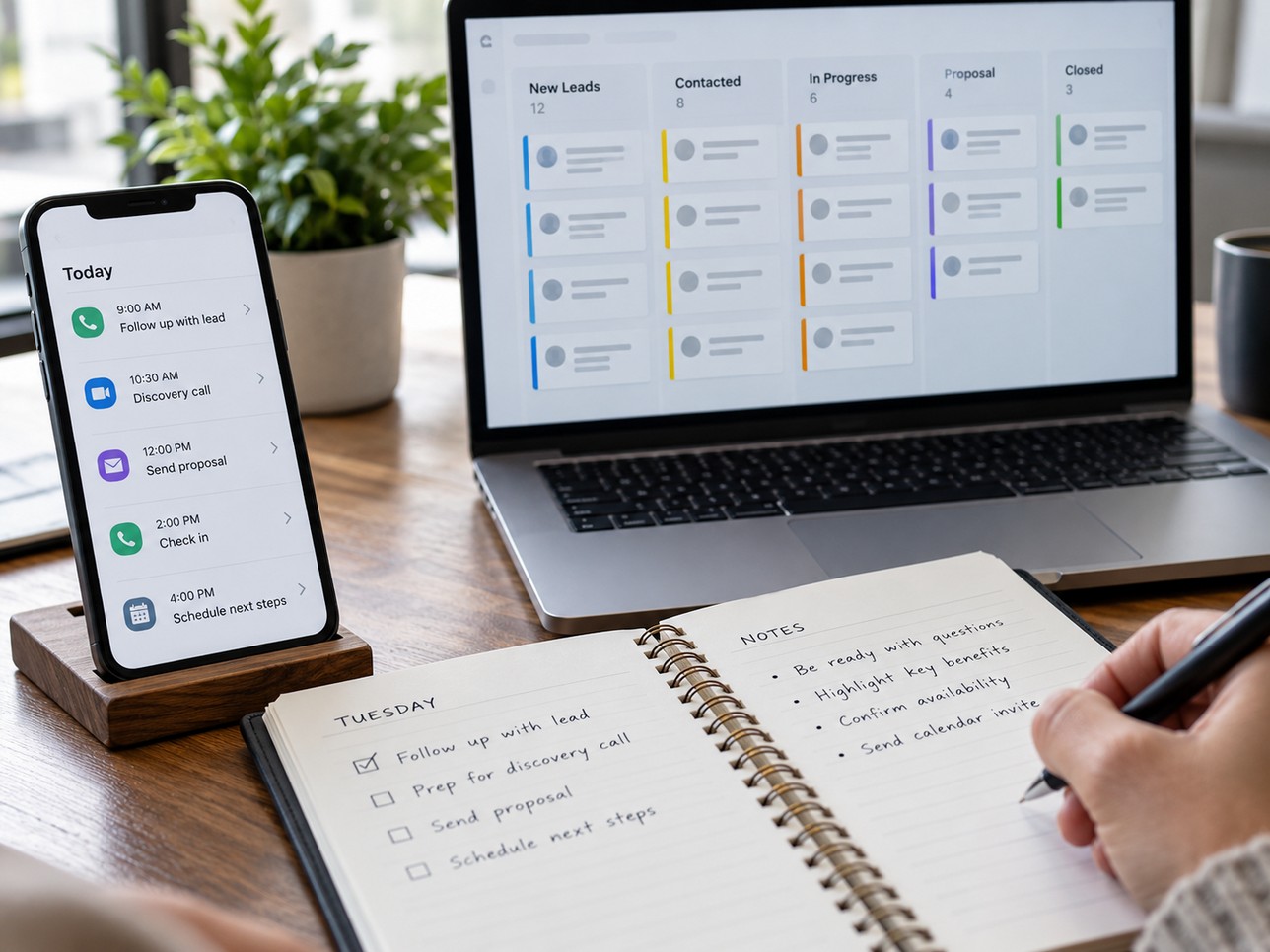
A clear response path turns inquiries into trackable next steps instead of loose ends.
4. Handoffs create invisible friction
A lead can be lost even after someone responds. One person answers the inquiry, another schedules the consultation, someone else owns the CRM, and no one is certain whether the prospect completed intake. Every handoff creates a place where momentum can stall.
A stronger lead management process defines what can be handled independently and what must be escalated. A support partner might answer an approved FAQ, ask a qualification question, provide a booking link, update the CRM, and flag anything outside scope. Delegare House uses that kind of boundary-setting so work can move without unauthorized promises.
For health and wellness businesses, those boundaries matter even more. Our non-clinical support for medspa, wellness, and telehealth teams keeps administrative follow-up moving while clinical decisions remain with the appropriate licensed team.
5. Generic messages can cool a warm lead
Speed matters, but speed without context can still feel careless. If someone asks about a specific service and receives a generic reply that does not acknowledge the question, the business has technically responded without creating much confidence.
Good warm lead follow-up should sound like the business. It should answer what can be answered, guide the prospect toward one clear next step, and know when to escalate. Templates are useful when they create consistency, not when they erase the reason the person reached out.
That is why hot lead follow-up works best with approved scripts, FAQs, qualification criteria, and escalation rules. You need enough structure that the response does not have to be reinvented every time.
6. CRM hygiene matters more than it seems
A messy CRM makes it hard to know who was contacted, who replied, who booked, and who still needs attention. Without visibility, your lead response time becomes difficult to measure and leads can fall out of view.
A practical lead management process keeps statuses current and records the next action.
HubSpot’s guidance on lead response time emphasizes the value of reducing response delays, while its sales analytics tools also support lead-response reporting. Response speed is something teams can track rather than guess.
The goal is not perfect data. It is making sure a promising inquiry does not disappear because no one can tell what happened next.
7. Build follow-up that does not depend on your memory
The best system is the one that still works when you are busy. Identify where leads come from, decide who owns each source, define your target lead response time, create a short warm lead follow-up cadence, and document what counts as qualified.
Then define the next step. Should the lead book a consultation, complete an intake, receive a quote, or return to checkout? A useful process moves each person toward a specific outcome rather than simply generating more messages.
For many solopreneurs and lean teams, the missing ingredient is not another sales platform. It is reliable capacity. Delegare House’s flexible monthly support can combine customer care, hot lead follow-up, CRM updates, scheduling, and recurring virtual operations so the process keeps moving while the founder focuses elsewhere.
Stop paying for leads you are too busy to follow
If your marketing is working but inquiries are still slipping through, the answer may not be more traffic. It may be a better response system. Faster, more consistent follow-up protects demand you already worked to create and gives prospects a smoother path toward becoming customers.
You should not have to choose between serving current customers and responding to the next one. If hot lead follow-up keeps landing back on your plate, hand us the process. Complete your
Delegare House handoff today, tell us where leads arrive and what should happen next, and we will help create the follow-up rhythm that keeps good opportunities from quietly going cold.
Sources & further reading
- Harvard Business Review’s research on online — hbr.org
- Salesforce’s small-business lead follow-up guidance — salesforce.com
- HubSpot’s guidance on lead response time — hubspot.com
Ready to make the backend lighter?
Tell Delegare House what keeps finding its way back to you, what can move independently, and what should always be escalated.
Start The Handoff →Explore Services